Key takeaways in this article:
- Interactive medical device demonstrations offer advantages over physical samples and prototypes, including versioning and scalability, that increase the volume and quality of sales interactions
- Immersive interactive medical product demos improve customer engagement, allowing them to experience using a device rather than simply watching how it’s used
- Interactivity accelerates understanding of complex medical devices by enabling users to rotate and zoom in on components
- Procedures that would be difficult or impossible to replicate outside the clinic or OR can be simulated using interactive digital technology
Getting a foot in the door with healthcare professionals (HCPs) and procurement teams can be a significant challenge for medical device sales teams. Interactive product demonstrations are the keys to open those doors, letting prospective customers experience device function and workflow firsthand and see the benefits for patients. In this article, we discuss the ways in which immersive and interactive technology is transforming medical device sales through better customer engagement.
How interactive medical device demos eliminate barriers associated with physical samples
Demonstrating the value of a medical device with the physical device itself–or a prototype–is beneficial to medical device sales teams in some situations. For example, a medical device sales rep may demonstrate how a drug-delivery nebulizer functions without medication, allowing customers to see how it is configured and operated for patients. Another example is a robot-assisted laparoscope operated in a congress booth with preloaded video to simulate the inside of a patient.
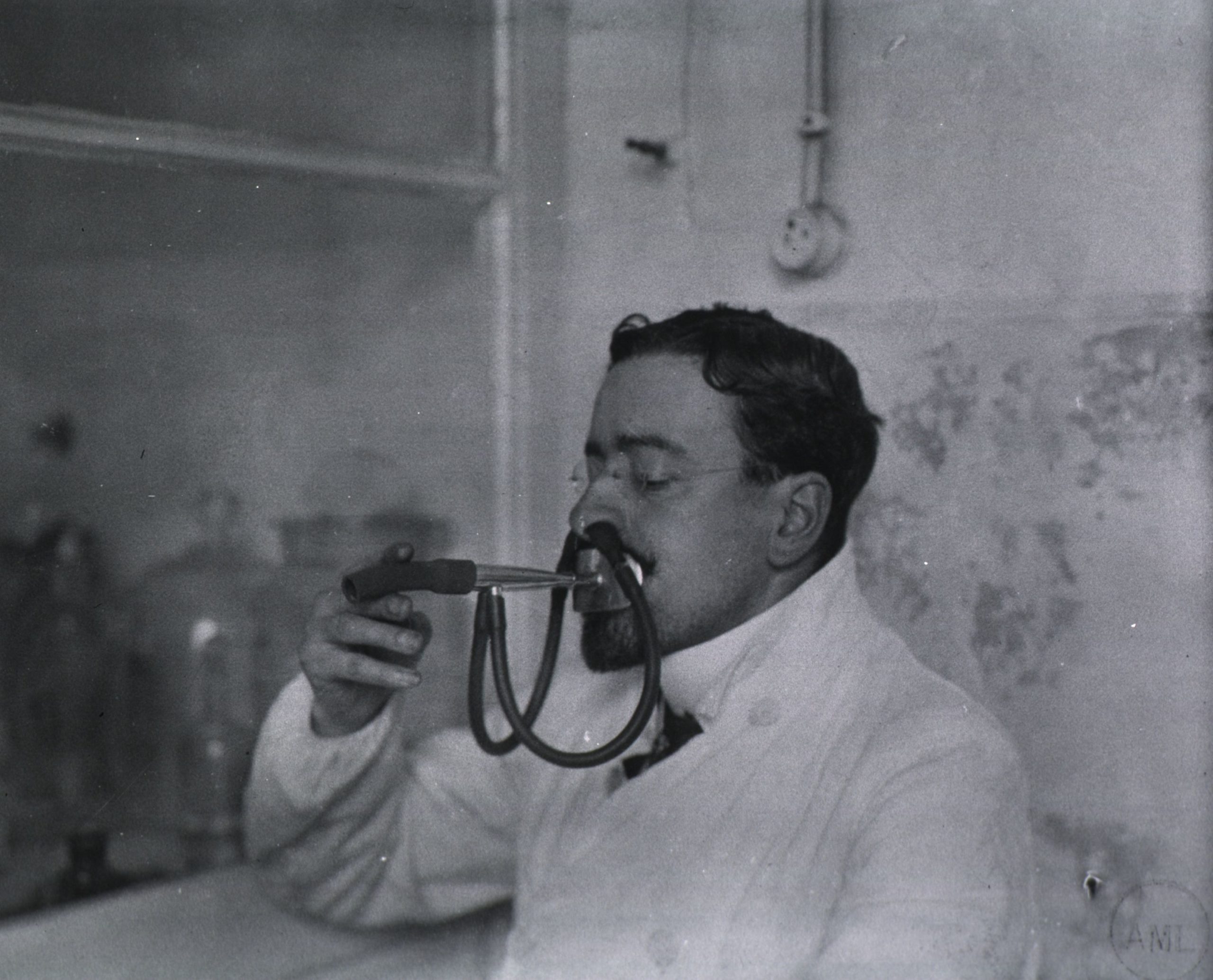
Dr. Cesare Capezzuoli (1879-1926) of Italy demonstrates the use of the Morelli combination mouth and nose-piece, c. 1913. Had interactive digital technology existed at the time, Dr. Capezzuoli might have spent less time with hoses in his nose. National Library of Medicine, public domain.
But physical medical device demos have drawbacks, limiting the quality and number of interactions with customers that interactive digital product demonstrations overcome. For instance:
- Scaleability: Medical devices themselves are expensive and demonstration models are finite in number, limiting how many are available for use at congresses and in the field. Instead, sales teams use interactive medical device demos which they can deploy to as many tablets, computers and touchscreen devices as needed. They benefit from being able to demonstrate products to customers wherever they are, in the office, the clinic, or a congress.
- Customer access: With more and more meetings taking place virtually, getting a physical device in front of a customer is increasingly difficult. With an interactive digital medical device demonstration, sales reps are interfacing with customers online, while going through a virtual product demo.
- Analytics: A digital medical device demo can record every action, choice, and button press by users. This data is parsed into an analytics report that provides actionable insights to the device sales team. With a demonstration medical device, it’s up to the presenter to log customer activity during a demonstration—a practice that is inconsistent across sales teams and venues.
- Staffing: Aligned with scalability, physical device demos are typically conducted one-on-one with a trained facilitator or sales representative. In contrast, interactive demos can be self-guided, eliminating the need for one-to-one representation and allowing multiple customers to experience the demonstration simultaneously.
- Security: Congress booth exhibits are busy places with many people coming and going. The loss or theft of a demonstration medical device can jeopardize proprietary control and land it in the hands of a rival company. This risk is eliminated completely with interactive digital technology.
- Logistics: Packing, shipping, receiving, and setting up a physical demonstration medical device is time consuming and expensive. Digital interactive medical device demos, on the other hand, are deployed instantly to tablets and touchscreens.
- Versioning: Medical device sales teams are sometimes equipped with prototypes and waste time and trust explaining to clients the updates that are not visible in the demonstration devices on hand. Interactive demonstrations are updated with the latest product version and pushed to sales teams and congress booths when needed.
- Damage or injury: While unlikely, there is the possibility that customers may damage a demonstration medical device or accidentally injure themselves with a sharp object in a physical demonstration. Interactive digital technology eliminates this risk.
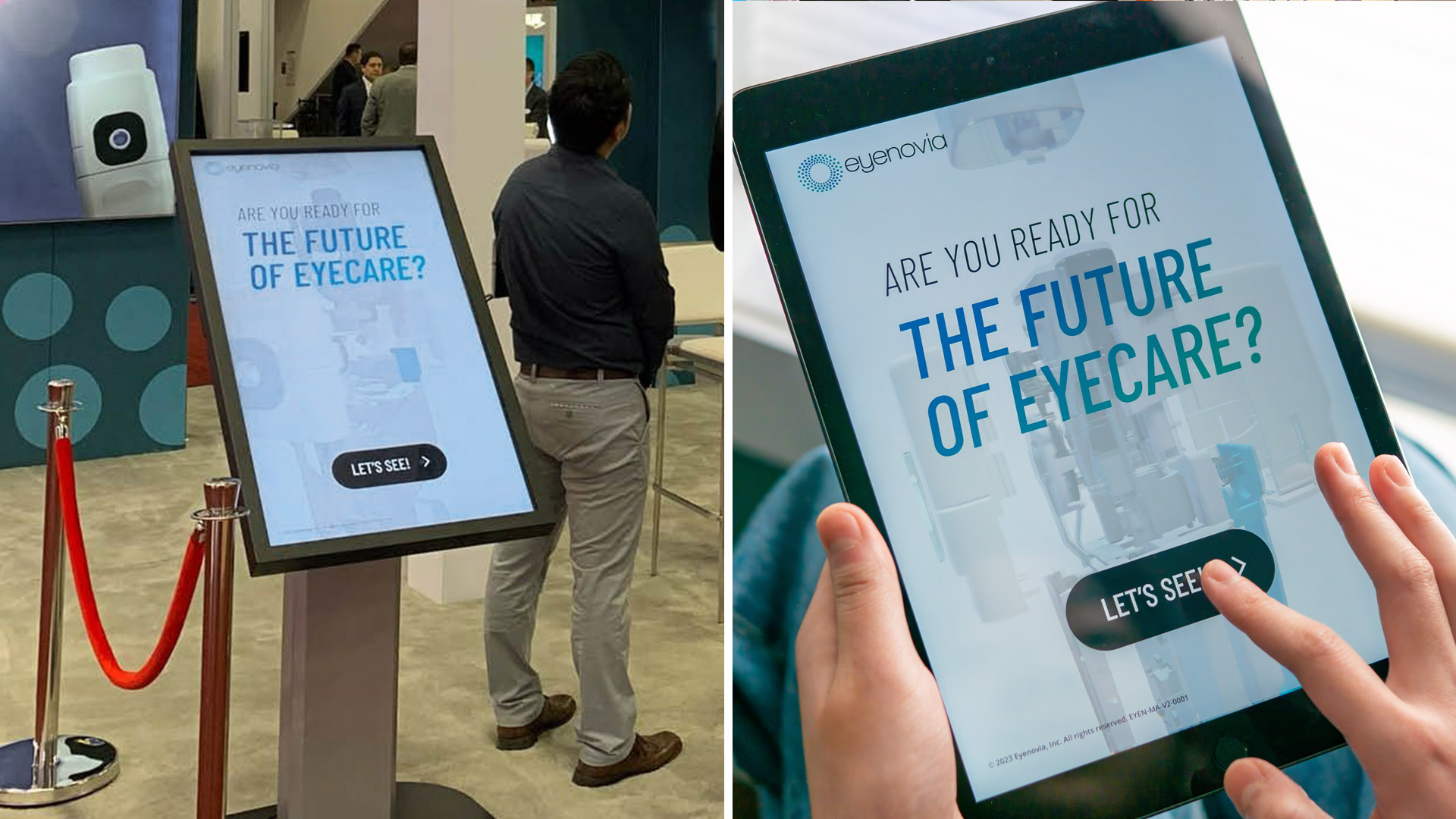
Interactive medical device demonstrations like this one are easily deployed to tablets and larger touchscreens for use in the field by sales representatives and at medical congress booths. They are used in one-on-one interactions and in a self-guided experience by customers, greatly expanding the reach of a sales team. The digital format makes versioning easy and eliminates the risk of loss or theft of valuable physical device samples.
Immersive medical device demos increase customer engagement through active participation
In traditional product demonstrations, representatives “present at” customers (HCPs and procurement managers). Immersive interactive medical product demos are transforming the experience from watching to simulating—from “this is how it works” to “this is how I use it”. Active participation has several benefits over passive viewing. When a customer is actively engaged, their attention is focused on your content instead of other priorities. Active participation also enables customers to experience how they would use a device in their own practice and workflow with patients. Unlike passive presentations which busy clinicians forget quickly, active demonstrations have been shown to improve retention and recall. As a result, the medical device is more likely to be remembered later, when it matters.
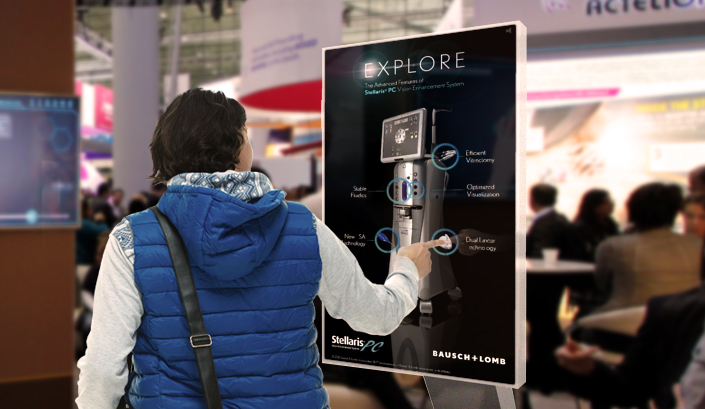
Immersive digital demonstrations of medical devices overcome many issues associated with physical samples, including expensive shipping and setup, versioning and the ability to deploy many instances of the demonstration to inexpensive tablets and touchscreens.
Go beyond touchscreens with immersive AR and VR medical device demonstrations
Augmented reality (AR) and virtual reality (VR) are taking immersive medical product demonstrations to the next level for medical device sales teams. AR combines a realtime camera view with digital content—often 3D models and animation—and functions on touchscreen devices like iPads and Samsung tablets, and wearable AR glasses. VR involves a headset displaying completely digital content, and mixed reality combines AR and VR to merge real world views with digital content inside a VR headset.
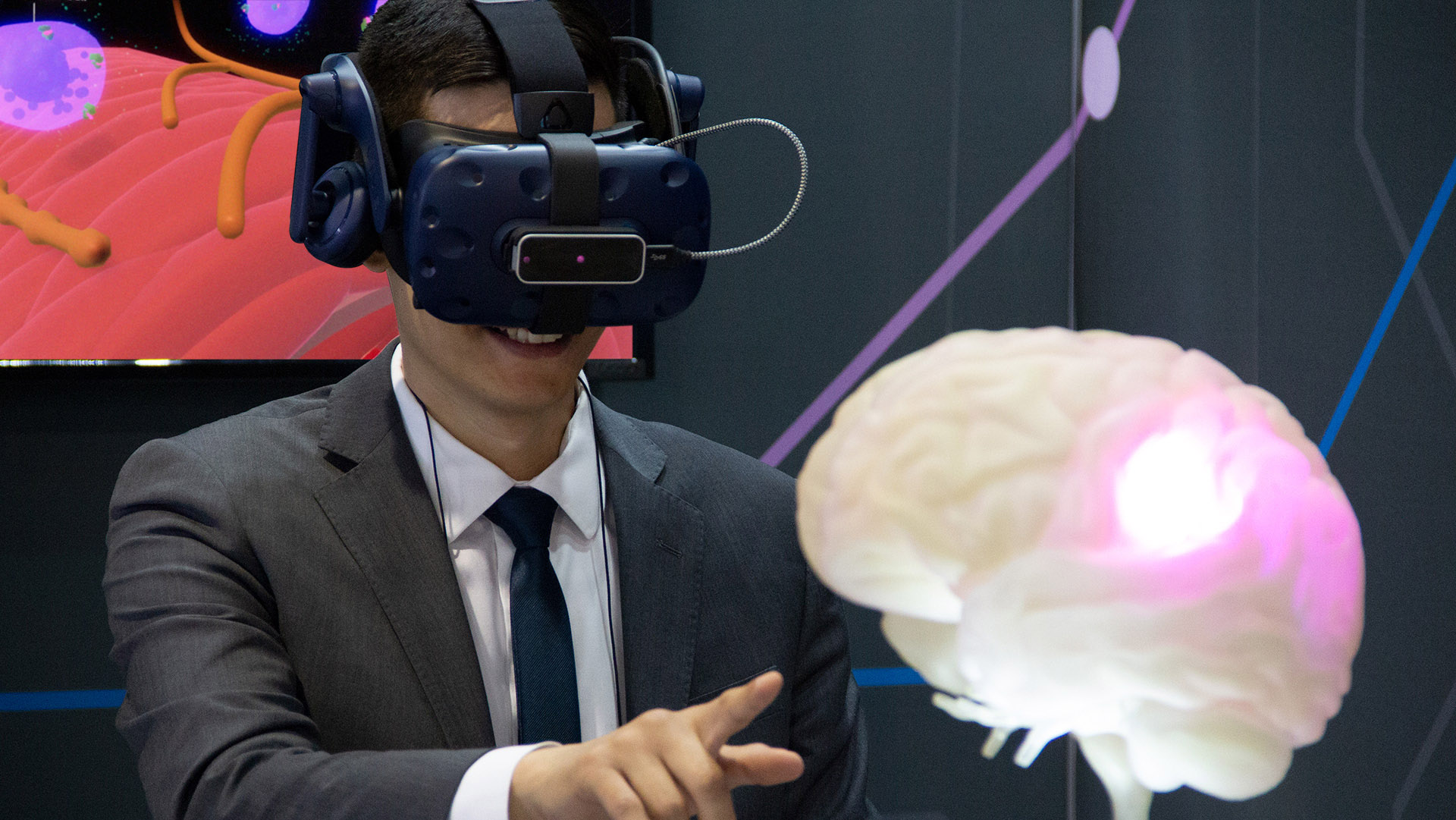
VR headsets with gesture control devices allow users to interact with virtual 3D worlds using their hands, increasing the sense of immersion in the content.
AR and VR are used instead of flat touchscreens and tables for medical device demonstration when a sense of 3D spatial relationships is essential.The advantages include:
- Seeing device position relative to anatomical landmarks
- Simulating use of a medical device in a realistic, high-fidelity environment
- Practicing steps in a procedure with real-time feedback
- Feeling what it’s like to use the device instead just seeing what it’s like
- Experiencing the device at its true scale
- Placing the customer in a virtual clinic or operating room
- When executed well, AR and VR are fun! Other people who see them in use are motivated to try out the demonstration
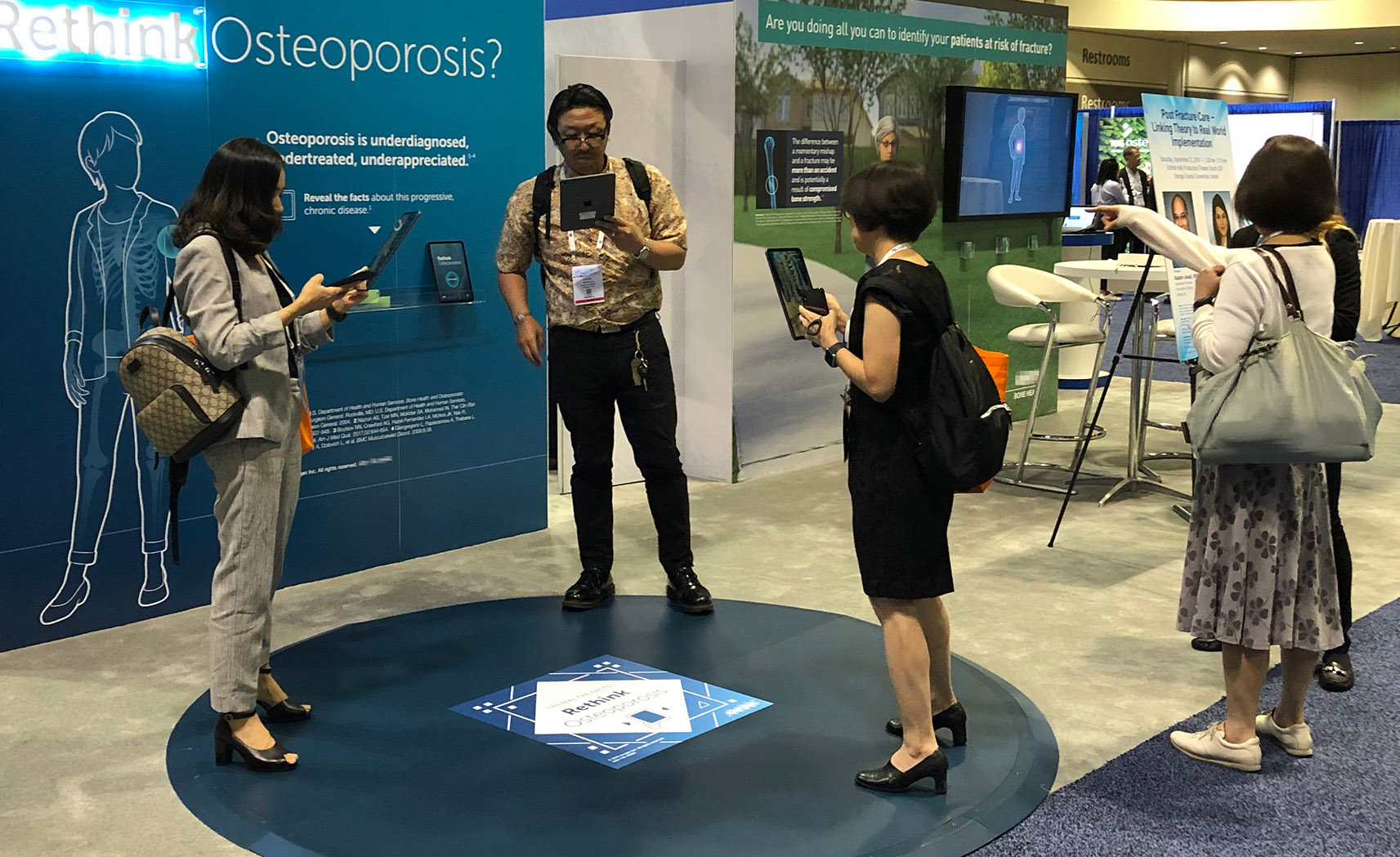
Augmented reality shows digital objects as if they are in the user’s environment. This provides customers with a sense of scale and makes exploring large devices accessible in any space. Interactive product demonstrations also overcome the scalability barrier of physical demos: multiple customers can interact with the content at once, leaving sales representatives free to engage others and field questions.
Interactivity accelerates understanding of complex medical devices through hands-on exploration
In a passive or linear demonstration of a complex medical device, viewers only see what is shown to them. The parts they cannot see must be imagined. In contrast, interactivity makes a complex device immediately understandable by enabling users to rotate and zoom in, explore components, and call out specific items they are interested in. Demonstrating the value of a medical device often involves highlighting internal components and their function, which is much easier with a digital interactive demo than a physical device.
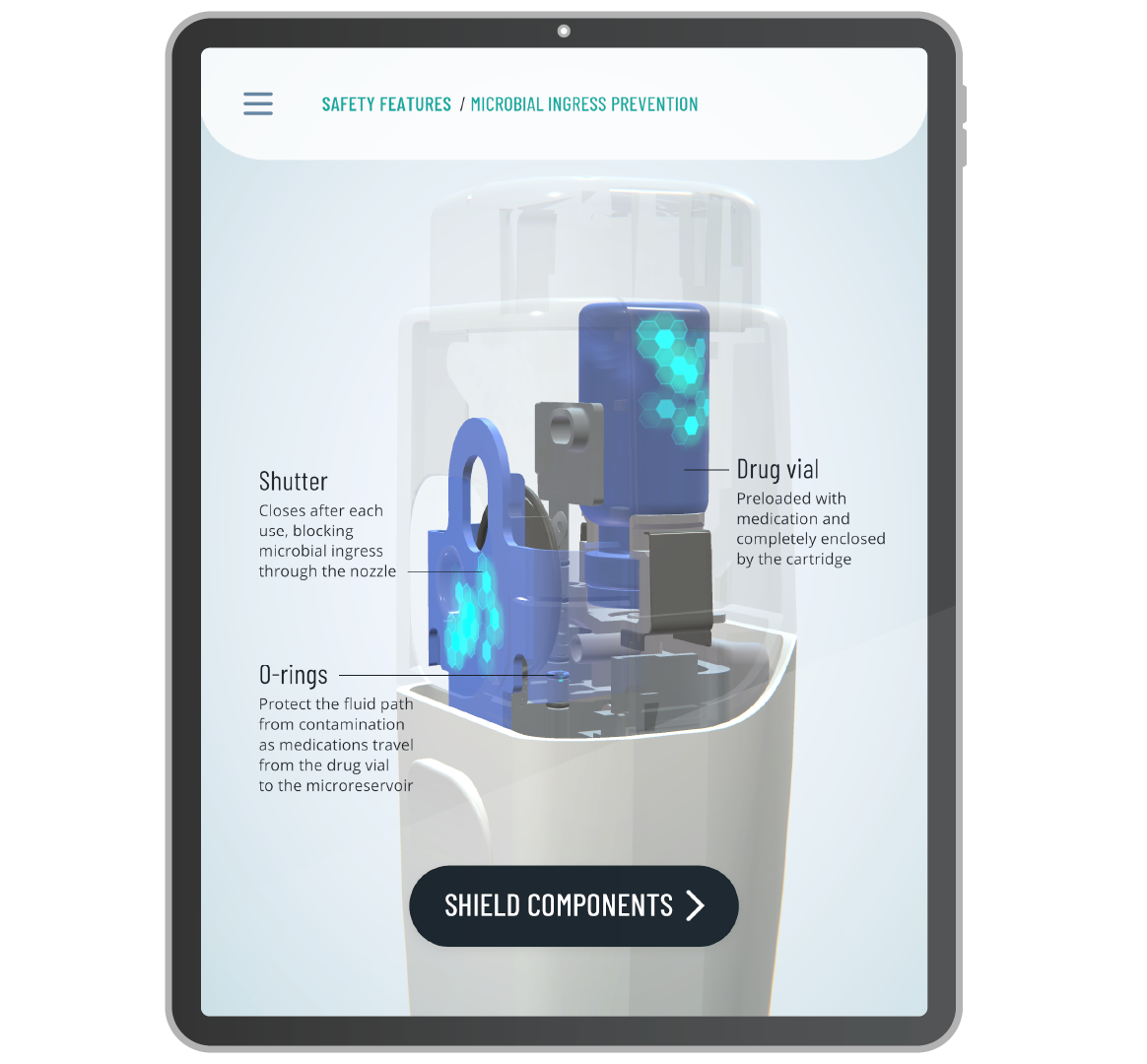
When the inner workings of a novel medical device are important to communicate to customers, an interactive demo makes it easy to reveal and highlight features in exploded and transparent views.
Interactive demonstrations simulate medical procedures that are difficult to replicate outside the clinic and OR
Many medical procedures are difficult or impossible to replicate outside of a hospital or clinic, simply because they involve patients and internal anatomy. This is where interactive medical device demonstrations excel because they depict virtual patients and internal anatomy with a high level of accuracy and detail. As a result, medical device companies are demonstrating new procedure workflows anywhere they interface with customers.
Demonstrating the value of a novel endoscopy system outside of an operating room is possible with a skilled medical animation and interactive team. What is traditionally an awkward two-handed, multi-instrument procedure is reduced to one instrument in one hand. The 3D digital format allows this workflow to be shown clearly, within seconds. And when a medical device prototype hasn’t yet been approved for human use, an interactive product demonstration can realistically simulate the procedure on a virtual patient.
In a demonstration or sales scenario, it’s essential for customers to grasp how a device would be used in their own clinical or surgical workflow. Interactivity allows customers to step through a procedure dynamically. Walking through a workflow like this enables an HCP to see how it might complement or improve upon their current practice.
Interactive medical device demonstrations enable customers to simulate the steps of a procedure like cardiac ablation to treat atrial fibrillation. Experiencing the workflow lets a customer envision using the device in their own practice.
Interactive and immersive technologies are changing the way medical device companies workshop and launch new products. The ability to demonstrate a device and procedure virtually anywhere has accelerated customer engagement in the field and at medical trade shows. Advantages like easy versioning of new features and scalability are why more and more medical device companies are leveraging digital interactive demonstrations.
Frequently asked questions
- Tablet computers
- Touch screen displays
- Reactive displays that use cameras and other sensors
- AR glasses
- VR headsets
An animation or interactive demo can:
- Save on shipping and versioning costs and increase scalability for a campaign
- Capture attention and show how the medical device will interact with the patient, tissues or organs
- Allow for a step-by-step demonstration to clarify complicated procedures
- Have assets that can be repurposed into patient education and marketing materials
Explaining the full capabilities and technical specifications of a medical device can be made easier in two ways: scaffolding the information for easy understanding; and allowing customers to do a self-guided demo at their own pace.
While the popularity of AR waxes and wanes over time (remember Pokemon Go?), a targeted and thoughtful AR demo of a medical device can be a very effective sales tool. AR has the advantage of contextualization—it places the device in the environment of the user, which makes the experience immediately more relevant and easier to map to real-world use. AR also shows depth and scale in a way that a flat screen does not. Overall AR is more memorable because it feels personalized and the technology itself still feels novel.
While it depends on the scope of the demonstration, most timelines are 16–20 weeks. This includes copy writing and wireframing—the core design stage.